

Why Financial Goals Require Inner Healing
Why Financial Goals Require Inner Healing — Not Just Better Planning
For many people, money feels heavier than any other area of life.
They can visualise health, relationships, purpose, or creativity with relative ease. But when it comes to income, stability, savings, or expansion, progress slows, stalls, or feels emotionally charged.
This is often misunderstood as a lack of discipline.
In reality, financial goals frequently activate the deepest layers of the nervous system. Money is not just practical — it is emotional, relational, and energetic.
This is why financial healing is not optional.
It is foundational.
Money Is Never Just About Numbers
Money is often treated as a purely logical subject.
But beneath budgets, salaries, and targets sit powerful associations formed early in life:
• safety or instability
• freedom or pressure
• worth or inadequacy
• control or helplessness
Even when someone understands money intellectually, the body may still respond from old patterns.
If money was associated with stress, inconsistency, responsibility beyond capacity, or conflict, financial growth can trigger anxiety rather than excitement.
The nervous system remembers what the mind has forgotten.
Why Financial Goals Trigger the Nervous System
Financial expansion often asks the nervous system to tolerate:
• increased responsibility
• visibility or scrutiny
• sustained effort
• fear of loss
• identity change
If the system does not yet feel safe holding these experiences, it will resist — not dramatically, but subtly.
Resistance may look like:
• avoidance
• procrastination
• inconsistent follow-through
• sudden loss of motivation
• cycles of effort and withdrawal
This is not self-sabotage.
It is protection.
Why Motivation Alone Rarely Works With Money
Many people say, “I know what to do — I just don’t do it.”
This is not a knowledge problem.
It is a regulation problem.
Motivation cannot override a nervous system that perceives financial growth as threatening.
Without healing, even well-designed plans feel heavy. The body unconsciously avoids what it associates with pressure or danger.
Inner healing works at the level where motivation fails — restoring safety so effort becomes possible.
Financial Healing Is About Capacity, Not Desire
Most people desire financial stability or growth.
What differs is capacity.
Capacity to:
• receive without guilt
• hold responsibility without overwhelm
• expand without collapse
• sustain success over time
Without sufficient capacity, growth may happen briefly — then retract.
This is why some people experience sudden financial gains followed by burnout, anxiety, or loss.
Inner healing increases capacity so growth can stabilise.
Identity Shifts and Financial Growth
Money often requires identity evolution.
Earning more, managing more, or leading more may challenge:
• family narratives
• cultural conditioning
• relational dynamics
• self-concept
Growth can feel disloyal, risky, or unfamiliar.
Healing supports this transition compassionately, allowing identity to evolve without self-betrayal.
Why Financial Growth Often Takes Time
When financial goals take time, it is often interpreted as failure.
In reality, it is frequently integration.
The nervous system learns safety through repetition, consistency, and honesty — not urgency.
Time allows new patterns to stabilise:
• new habits
• new beliefs
• new emotional responses
• new self-trust
Growth that integrates slowly tends to last.
Spiritual Integrity and Money
Money is often excluded from spiritual conversations or treated with discomfort.
Yet true spiritual integrity includes:
• grounded responsibility
• ethical expansion
• honest self-assessment
• embodied choice
Avoiding money does not make one more spiritual.
Integrating money into wholeness does.
Financial healing bridges spirituality and practicality rather than separating them.
Why Financial Healing Needs Structure
Healing without structure can drift.
Awareness alone does not always translate into changed behaviour.
Structure provides containment and safety:
• reflection reduces overwhelm
• tracking builds self-trust
• review prevents avoidance
• rhythm supports regulation
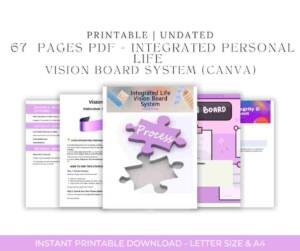
This is why I created the Integrated Life Vision Board System.
It includes financial visioning alongside:
• emotional wellbeing
• energy levels
• boundaries
• inner peace
So money is never pursued at the expense of health or integrity.
Financial Vision Held Within the Integrated Life Vision Board System
Within the Integrated Life Vision Board System, financial goals are treated as part of a whole life — not as isolated targets.
The system supports:
• clear financial vision writing
• monthly reflection on income, spending, and habits
• honest tracking without shame
• quarterly course correction
• annual integration of lessons learned
This approach respects nervous system safety while still supporting growth.
Structure is used to support healing — not override it.
Vision Boards as Mirrors for Financial Healing
Integrated Life Vision Board System
A financial vision board is not a demand.
It is a mirror.
It reveals:
• where expansion feels natural
• where fear emerges
• where beliefs need questioning
• where compassion is required
When approached this way, vision becomes information rather than pressure.
The Integrated Life Vision Board System treats vision as a dialogue, not a command.
Whole-Life Healing Supports Financial Stability
Financial wellness does not exist in isolation.
It is influenced by:
• emotional regulation
• spiritual grounding
• mental clarity
• relational boundaries
Ignoring one area eventually destabilises the others.
Whole-life healing creates the conditions for financial stability that does not cost peace.
When Money No Longer Feels Heavy
With healing and structure, something shifts.
Money no longer feels charged with fear or urgency.
Decisions become clearer.
Boundaries become firmer.
Receiving becomes safer.
Growth still requires effort — but it no longer feels self-threatening.
Financial Growth That Lasts
Lasting financial growth is not built on urgency or pressure.
It is built on:
• internal safety
• honest reflection
• aligned structure
• compassionate discipline
This is the foundation of financial healing — and the philosophy behind Sara Inner Healing and the Integrated Life Vision Board System.
Closing Reflection
If financial progress feels slower than expected, it does not mean you are behind.
It may mean your system is learning how to hold stability rather than volatility.
When inner healing is honoured, financial growth stops feeling forced.
It becomes sustainable.
