
What Is Coaching
A Complete Guide to Understanding Coaching and Choosing the Right Approach
“The greatest transformation in life is not changing what you do, but changing who you become and how you do what you do.”
— Sara Ahavah
Coaching is a structured and collaborative process that helps individuals move from where they are today to where they want to be. Rather than giving advice or solving problems for people, coaching helps individuals develop the awareness, confidence and practical skills needed to solve problems themselves and create lasting change.
At its heart, coaching is about unlocking human potential. It encourages people to think more deeply, question assumptions, recognise limiting beliefs and discover solutions that align with their own values and aspirations.
Unlike training, which teaches knowledge and skills, coaching focuses on developing awareness and applying existing knowledge more effectively. The emphasis is not simply on achieving goals but on becoming the kind of person capable of achieving and sustaining those goals.
Today, coaching is used in almost every area of life, including career development, leadership, business, emotional wellbeing, relationships, finances, health and spiritual growth.
The greatest benefit of coaching is that it develops independent thinking. Rather than creating dependence on the coach, effective coaching equips people with the confidence and self-awareness to continue growing long after the coaching relationship has ended.
Coaching vs Mentoring: Understanding the Difference
Many people confuse coaching with mentoring because both help individuals develop personally and professionally. While they share a common purpose, they achieve it in different ways.
Coaching
A coach helps clients discover their own answers.
Rather than providing advice, coaching uses powerful questions, active listening and reflective techniques to help individuals gain clarity, challenge limiting beliefs and identify practical solutions.
A coach believes the client already possesses many of the answers but may need support in uncovering them.
Examples of Powerful Coaching Questions
A coach may ask questions such as:
- What outcome would you most like to achieve?
- What is preventing you from moving forward?
- What assumptions are you making?
- How do you feel about this situation?
- Which emotions are influencing your decision?
- What belief may be limiting you?
- If fear wasn’t present, what would you choose?
- What options have you not yet considered?
- What strengths can you draw upon?
- What would success look like for you?
- What action could you take this week?
- What has this experience taught you about yourself?
Notice that none of these questions provide answers. Instead, they encourage reflection, helping the client develop deeper awareness and confidence in their own judgement.
Coaching Example
A client feels trapped in an unfulfilling career but cannot decide whether to leave.
Rather than telling the client what to do, the coach explores the client’s values, fears, motivations and long-term aspirations until the client gains the clarity to make an informed decision independently.
Mentoring
A mentor shares knowledge gained through personal experience.
Unlike coaching, mentoring often involves giving advice, recommending strategies and explaining what has worked in similar situations.
Mentors usually possess specialist expertise in a profession, business or field and help others benefit from that experience.
Examples of Mentoring Questions
A mentor is more likely to ask questions such as:
- What career path are you hoping to follow?
- What experience do you already have?
- Have you considered obtaining this qualification?
- Would you like me to show you how I approached this challenge?
- Have you spoken with someone working in this field?
- What challenges are you facing in your current role?
- Would it help if I shared what worked for me?
- Have you considered these practical options?
These questions often lead naturally into guidance based on the mentor’s own experience.
Mentoring Example
A newly qualified accountant wants to become a Finance Director.
An experienced Finance Director mentors them by sharing lessons learned throughout their own career, recommending leadership development opportunities, explaining common mistakes to avoid and introducing useful professional networks.
Coaching and Mentoring Compared
| Coaching | Mentoring |
|---|---|
| Facilitates discovery | Shares experience |
| Uses powerful questions | Provides advice and guidance |
| Develops self-awareness | Develops knowledge and expertise |
| Encourages independent thinking | Transfers practical wisdom |
| Helps clients find their own answers | Offers recommendations based on experience |
| Future-focused | Experience-informed |
Both coaching and mentoring are valuable. Many people benefit from both. A mentor may provide knowledge and direction, while a coach helps individuals develop the awareness, confidence and emotional resilience needed to apply that knowledge effectively.
The Different Types of Coaching
As coaching has evolved, specialist disciplines have emerged to address different aspects of personal and professional development.
Although each type has a different emphasis, they all aim to help individuals achieve positive and sustainable change.
Life Coaching
Life coaching supports individuals seeking greater balance, confidence, fulfilment and purpose. It helps people clarify goals, overcome obstacles and make decisions that align with the life they genuinely want to create.
Transformational Coaching

Transformational coaching focuses on deep, lasting change rather than simply achieving external goals. It explores identity, beliefs, emotions and behaviour to help individuals become the person capable of sustaining meaningful transformation.
Rather than asking only “What do you want to achieve?”, transformational coaching also asks “Who do you need to become?”
Emotional Coaching
Emotional coaching develops emotional awareness and emotional intelligence.
Individuals learn to recognise emotional triggers, regulate emotions more effectively, build resilience and respond to life’s challenges with greater wisdom rather than reacting impulsively.
Mindset Coaching
Mindset coaching focuses on changing patterns of thinking.
Many limitations in life arise not from lack of ability but from limiting beliefs, negative self-talk and unhelpful thinking habits.
Mindset coaching helps individuals develop healthier beliefs, greater confidence and a growth mindset that supports continuous learning and personal development.
Career Coaching
Career coaching helps individuals identify career goals, improve employability, prepare for interviews, transition into new roles, develop leadership skills and make informed professional decisions.
Financial Coaching
Financial coaching helps individuals develop healthier financial habits, improve budgeting, reduce debt, increase savings and build long-term financial confidence. It recognises that financial decisions are often influenced by emotions, beliefs and personal behaviours as much as knowledge.
Executive and Leadership Coaching
Executive coaching supports leaders in strengthening communication, strategic thinking, emotional intelligence, decision-making and leadership effectiveness. It helps leaders navigate complexity while developing high-performing teams.
Business Coaching
Business coaching supports entrepreneurs and business owners in improving leadership, strategy, marketing, financial performance and sustainable business growth.
Health and Wellness Coaching
Health coaching encourages healthier lifestyles through improved nutrition, physical activity, sleep, stress management and sustainable wellbeing habits that enhance quality of life.
Relationship Coaching
Relationship coaching helps individuals improve communication, establish healthy boundaries, resolve conflict and develop stronger personal and professional relationships.
Spiritual Coaching
Spiritual coaching is often misunderstood because people assume it relates only to religion. In reality, spiritual coaching is concerned with the deeper questions that influence every area of human life.
It explores questions such as:
- Why am I here?
- What gives my life meaning?
- What kind of person am I becoming?
- How do I find lasting fulfilment rather than temporary happiness?
- How can I align my life with my deepest values and purpose?
Where emotional coaching helps individuals understand their feelings, and mindset coaching helps reshape patterns of thinking, spiritual coaching asks an even deeper question:
What is the purpose behind the life I am living?
Within the Sara Inner Healing framework, spiritual coaching is the integrating dimension that brings emotional awareness, mental clarity and purposeful action together.
Transformation rarely occurs simply because someone gains knowledge.
People often know what they should do but struggle to do it consistently.
Why?
Because behaviour is influenced by emotions.
Emotions are influenced by thoughts.
Thoughts are influenced by beliefs.
Beliefs are shaped by the deeper values and purpose through which people interpret life.
This is why sustainable transformation requires alignment at multiple levels.
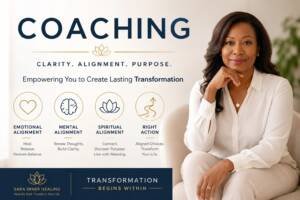
Emotional alignment helps individuals process fear, shame, anger, anxiety, guilt and emotional pain.
Mental alignment helps individuals recognise limiting beliefs, develop healthier thinking patterns and cultivate greater psychological resilience.
Spiritual alignment connects both emotional and mental growth to a deeper purpose, encouraging individuals to live according to values rather than circumstances.
When these dimensions become aligned, behaviour naturally changes.
People establish healthier boundaries.
Relationships improve because they become less reactive and more compassionate.
Financial decisions become wiser because they are no longer driven by fear, insecurity or impulse.
Acts of kindness become intentional rather than occasional.
Forgiveness becomes possible because identity is no longer defined by past wounds.
Purpose becomes clearer because life is viewed through principles rather than temporary emotions.
Within Sara Inner Healing, spiritual coaching incorporates reflective practices, gratitude, meditation, forgiveness, healing prayers and spiritual disciplines that encourage individuals to cultivate love, compassion, responsibility and service to others.
Spiritual growth is therefore not an escape from everyday life but the foundation upon which emotional wellbeing, mental resilience and purposeful living are built.
Ultimately, right action becomes the natural expression of inner transformation rather than behaviour maintained through willpower alone.
Choosing the Right Coaching Approach
There is no single coaching discipline that meets every person’s needs.
Someone seeking career success may also need emotional resilience.
Someone seeking financial wellbeing may need to overcome fear, develop healthier thinking patterns and build confidence.
Someone recovering from trauma may benefit from emotional coaching, mindset coaching and spiritual coaching working together.
For this reason, the most effective coaching is often holistic and tailored to the unique needs of the individual rather than confined to one specialist category.
Coaching is ultimately about helping people become more self-aware, emotionally resilient, mentally clear and purpose-driven so they can make wiser decisions, build healthier relationships and live more meaningful lives.
Whatever the starting point, lasting transformation begins within. When emotional alignment, mental alignment and spiritual alignment come together, right action follows naturally, enabling individuals not only to change what they do but also to become the person they were created to be.
Resources that supported my transformational journey can be accessed below.