
Kabbalah
A Beginner’s Guide to Ancient Spiritual Wisdom- What is Kabbalah?
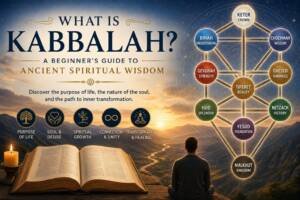
Kabbalah is one of the oldest and most profound spiritual teachings in the world. For centuries, it was studied by a small group of dedicated seekers who wanted to understand the deeper purpose of life, the nature of the soul, and humanity’s relationship with the Creator.
Today, interest in Kabbalah is growing rapidly as more people search for answers to life’s biggest questions:
- Why am I here?
- What is the purpose of life?
- Why do we suffer?
- Can lasting happiness be achieved?
- Is there a deeper reality beyond what we perceive with our five senses?
Kabbalah offers a practical framework for exploring these questions and transforming our lives from within.
In this guide, we will explore what Kabbalah is, its core teachings, and how it can help us develop greater meaning, purpose, and spiritual awareness.
What Does Kabbalah Mean?
The word “Kabbalah” comes from a Hebrew word meaning “to receive.”
Kabbalah For Beginners
However, Kabbalah is not simply about receiving knowledge. It is the wisdom that teaches how human beings can receive the highest form of fulfillment by developing a deeper connection with the Creator.
Kabbalah explains that behind everything we experience exists a single force of love, giving, and connection. The purpose of spiritual development is to become aware of this force and gradually develop qualities that align with it.
Is Kabbalah a Religion?
One of the most common misconceptions is that Kabbalah is a religion.
Kabbalah is not a religion. It is a spiritual wisdom that explores the laws governing reality and human consciousness.
People from all backgrounds, cultures, and beliefs study Kabbalah because it addresses universal questions about life, purpose, relationships, suffering, and personal transformation.
Rather than focusing on rituals or external practices, Kabbalah focuses on inner development and the correction of human desire.
The Central Question of Kabbalah
At the heart of Kabbalah lies a simple yet profound question:
What is the purpose of life?
Most people spend years pursuing success, wealth, relationships, recognition, and comfort. Yet many eventually discover that external achievements alone cannot provide lasting fulfillment.
Kabbalah teaches that the desire to discover the meaning of life is a natural stage of human development.
When this question awakens within us, it signals the beginning of a spiritual journey.
The Nature of Human Desire
According to Kabbalah, human beings are fundamentally driven by desire.
Throughout life we seek:
- Pleasure
- Knowledge
- Power
- Security
- Love
- Recognition
These desires are not wrong. They are part of human nature.
However, Kabbalah teaches that our desires continue to evolve until we eventually seek something deeper—a connection with the source of life itself.
This spiritual desire is often described as a “point in the heart.”
Who Is the Creator?
In Kabbalah, the Creator is not viewed as a physical being.
The Creator is understood as the universal force of love, giving, and connection that sustains all reality.
The goal of spiritual development is not to worship an external force but to gradually acquire qualities similar to the Creator.
This process is known as achieving similarity of form.
As we develop greater love, compassion, unity, and concern for others, we become more aligned with the spiritual reality described by Kabbalah.
What Is the Soul?
Kabbalah teaches that the soul is not the physical body.
The soul is our capacity to perceive and connect with the higher reality beyond ordinary perception.
The soul develops gradually through spiritual work, study, and inner transformation.
As the soul develops, a person begins to perceive deeper levels of reality and experiences greater purpose, meaning, and connection.
The Tree of Life
One of the most recognised symbols associated with Kabbalah is the Tree of Life.
The Tree of Life represents the structure through which spiritual energy flows into creation.
It describes different stages of spiritual development and illustrates how the Creator’s qualities are revealed within the human soul.
While the Tree of Life is often presented as a mystical diagram, its deeper purpose is to explain the process of inner transformation.
What Is Tikkun HaNefesh?
A central concept in Kabbalah is Tikkun HaNefesh, which means “correction of the soul.”
Kabbalah teaches that human suffering often arises from our egoistic nature—our tendency to focus primarily on ourselves.
Spiritual growth involves gradually transforming our desires from self-centeredness toward connection, contribution, and love of others.
This process is not about perfection.
It is about continuous inner correction and growth.
Every challenge, relationship, and life experience becomes an opportunity for spiritual development.
Faith Above Reason
One of the most powerful teachings in Kabbalah is the concept of Faith Above Reason.
This does not mean blind belief.
Instead, it refers to developing trust in the higher purpose and guidance of reality even when our ordinary understanding is limited.
Many of life’s most significant transformations occur when we move beyond fear, doubt, and ego-based thinking.
Faith Above Reason allows us to continue moving toward connection, growth, and unity even during difficult circumstances.
Why Do We Suffer?
Kabbalah teaches that suffering is not punishment.
Rather, suffering often serves as a signal that something within us requires correction or growth.
Challenges can awaken deeper questions about life, encourage personal transformation, and motivate us to seek a more meaningful existence.
From a Kabbalistic perspective, difficulties become opportunities for spiritual development rather than obstacles to happiness.
How Kabbalah Relates to Daily Life
Many people assume Kabbalah is purely theoretical or mystical.
In reality, Kabbalah provides practical guidance for everyday life.
Its teachings can help us:
- Improve relationships
- Develop gratitude
- Overcome resentment
- Cultivate compassion
- Find purpose
- Build resilience
- Strengthen emotional wellbeing
- Develop spiritual awareness
The wisdom of Kabbalah is intended to be lived, not merely studied.
How to Begin Studying Kabbalah
If you are new to Kabbalah, begin with foundational teachings.
Focus on understanding:
- The purpose of life
- The nature of desire
- The soul
- The Creator
- Faith Above Reason
- Tikkun HaNefesh
Most importantly, approach the study with curiosity and a desire for personal growth.
Kabbalah is not simply information to be learned. It is a path of inner transformation.
Join our private Kabbalah For Beginners Community to access this course. Over 1500 students.
Conclusion
Kabbalah is a profound spiritual wisdom that seeks to answer humanity’s deepest questions about life, purpose, and the soul.
Far from being a collection of mystical ideas, Kabbalah provides a practical framework for personal transformation, emotional healing, and spiritual growth.
It teaches that behind the apparent complexity of life exists a single force of love and connection, and that the purpose of our journey is to develop qualities that align with that force.
Whether you are searching for meaning, healing, purpose, or a deeper understanding of reality, Kabbalah offers timeless insights that can help guide your path toward greater awareness, connection, and fulfillment.