
What Is Micro-Gratitude? (And 5 Ways to Practice It in Under 60 Seconds)
In the busy rush of modern life, maintaining a dedicated, long-form personal development routine can feel like a daunting task. When you are already juggling a packed schedule, struggling with mental fatigue, or dealing with chronic overwhelm, being told to sit down with a blank notebook and write pages of positive reflections can actually create more stress. You might find yourself avoiding the practice entirely, feeling guilty that you don’t have the time or the emotional bandwidth to show appreciation for your life.
This is where a profound shift in perspective becomes necessary. True mindfulness isn’t measured by the length of your journal entries; it is measured by the quality of your immediate awareness. By shifting your focus from massive, time-consuming milestones to tiny, intentional moments, you uncover a highly accessible self-care secret: micro-gratitude. This low-barrier approach allows you to experience deep inner healing without demanding a single spare minute from your day.
What Is Micro-Gratitude?
10_Day_Micro_Gratitude_Challenge CLICK TO DOWNLOAD
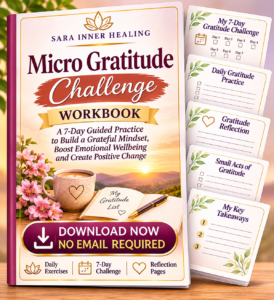
Sara Inner Healing Gratitude Challenge Workbook
10_Day_Micro_Gratitude_Challenge
Micro-gratitude is the intentional practice of identifying, acknowledging, and feeling a brief flash of appreciation for tiny, highly specific details in your immediate environment. Unlike traditional mindfulness, which often asks you to sit quietly and reflect broadly on major life blessings, micro-gratitude is fast, localized, and highly practical. It requires zero journal pages, no quiet meditation rooms, and absolutely no lifestyle changes.
The beauty of this framework lies in its ability to bypass your mind’s natural defense mechanisms. When you are under intense pressure or dealing with deep emotional blocks, your analytical brain will often argue with massive positive declarations. However, it cannot argue with a micro-glimmer. Acknowledging that the handle of your favorite mug feels smooth or that a room is pleasantly warm takes less than three seconds, making it a completely non-threatening exercise for an exhausted or anxious nervous system.
The Neurobiology of Tiny Moments
Every single time you pause to notice a micro-glimmer of comfort, you are actively participating in structural brain training. Your brain possesses a deep-seated evolutionary mechanism known as the negativity bias, which causes your mind to scan your environment constantly for threats, flaws, and problems to keep you safe. Left unmanaged, this bias overstimulates your nervous system, locking you into a persistent state of fight-or-flight.
When you practice a 60-second flash of appreciation, you temporarily interrupt that threat loop. This brief pause acts as a gentle signal to your vagus nerve, indicating that you are safe in the present moment. Over time, these tiny, repetitive updates accumulate. By systematically sprinkling micro-moments of comfort throughout your afternoon, you gradually build new neural pathways, making emotional resilience your mind’s natural default setting.
5 Ways to Practice Micro-Gratitude in Under 60 Seconds
To help you seamlessly integrate this framework into a chaotic day, lean on these five low-energy, practical exercises that take less than a minute to complete:
1. The Sensory Snapshot
No matter where you are standing or sitting, pause for 30 seconds and find three distinct physical details that feel neutral or pleasant. Notice the soft texture of your clothing against your skin, the steady supportive pressure of the floor beneath your feet, or the exact temperature of the air as you breathe in. Simply naming these sensations anchors your wandering thoughts directly back to physical safety.
2. The Mundane Tool Reframe
We interact with hundreds of everyday objects that make our lives easier, yet we rarely notice them until they stop working. Take 15 seconds to look at a tool in your hand—your phone, a smooth pen, a reliable key, or a warm running tap—and offer a silent nod of thanks for the hidden ease it brings to your routine.
3. The Breathing Constant
When your schedule begins to spin out of control, close your eyes or soften your gaze for three slow breaths. Do not try to alter your state; simply appreciate the fact that your lungs are automatically expanding and contracting to protect you without requiring any active direction from your logical mind.
4. The Digital Intermission
Before you unlock your phone to scroll through social media or check your inbox, stare at the blank lock screen for five seconds. Acknowledge the comfort of your immediate room, take one deep breath, and use that brief intermission to anchor your system before absorbing digital noise.
5. The Internal Defense Validation
If an uncomfortable emotion like anxiety or frustration spikes during a difficult transition, do not try to suppress it. Spend 45 seconds using shadow work principles to validate its presence. Mentally thank the emotion for trying to protect you from uncertainty, and gently remind your system that you can handle the moment safely.
Overcoming Spiritual Blocks: Weaving Prayers into Your Habits
There are seasons when your internal resistance runs so deep that practicing simple mindset shifts feels completely empty. In spiritual traditions, this persistent emotional numbness or chronic mental static is often viewed as a block within the soul’s energetic blueprint. When you encounter a wall that practical mental tools cannot seem to break through, it is incredibly powerful to elevate your everyday adjustments into the realm of sacred, timeless intervention.
To gently dissolve these deep-seated spiritual barriers and restore your capacity to feel authentic appreciation, you can bridge your micro-moments with traditional sacred keys. Taking a brief pause to read or meditate on timeless spiritual structures can realign a chaotic energetic state instantly. If you are ready to explore these ancestral keys to cleanse your aura and clear your path, dive into our curated Kabbalistic Prayers & Psalms For Healing Master Glossary to discover targeted spiritual support for your soul’s journey.
Weaving Your Self-Care Elements Together
Micro-gratitude is designed to serve as the gentle entry point to a much deeper inner healing ecosystem. Once these 60-second habits begin to stabilize your everyday nervous system, your capacity to engage with long-form reflective tools will naturally expand. If you find your energy returning and feel an intuitive pull to sit down for a deeper written session, you can read our guide on how do I start a gratitude practice to design a slow, sustainable journaling routine.
For those days when you are ready to commit your insights to paper, utilising dedicated templates removes the exhaustion of a blank page. Working within layouts like The Ultimate Gratitude Journal For Women or The Ultimate Gratitude Journal For Men gives your evolving habits a safe, beautiful home. Additionally, if your current mindfulness journey is unfolding during a season of intense personal hardship or deep emotional mourning, pairing your quick micro-habits with structured frameworks for balancing finding gratitude in difficult times or navigating grief and gratitude will keep your spirit completely protected. Treat your heart with absolute gentleness, knowing that every tiny glimmer you notice is a profound step toward your highest self.