
The 10-Day Gratitude Challenge for Overwhelmed Minds
When your mind is constantly racing with daily obligations, unexpected transitions, or deep emotional fatigue, introducing a new wellness routine can feel incredibly intimidating. Traditional self-care challenges often demand that you make sweeping lifestyle changes, spend hours in silent meditation, or write pages of prose in a notebook every single day. For an already overextended nervous system, this high-pressure approach creates an immediate sense of friction, causing you to avoid the practice entirely before you even begin.
Real, lasting inner healing is never achieved through aggressive, dramatic leaps. It is built systematically through the quiet accumulation of tiny choices. If you are ready to break free from chronic stress and reset your baseline perspective, you need a structured, low-barrier entry path. This 10-day gratitude challenge is explicitly engineered for busy, overwhelmed minds. By focusing on ultra-low-energy exercises, you can bypass your brain’s natural resistance and build a durable habit of peaceful appreciation in less than two minutes a day.
The Psychology of the 10-Day Habit Loop
Many people fail to stick with personal development goals because they set their initial expectations far too high. When you commit to a strict, open-ended 30-day or 90-day program while operating on low emotional energy, your brain perceives the goal as a threat to its remaining survival reserves. Your subconscious mind steps in to protect you by triggering procrastination, boredom, or total avoidance.
By narrowing your focus to a strict, highly manageable 10-day window, you dramatically lower that internal resistance. Ten days is the psychological sweet spot: it is long enough to provide tangible changes to your neurochemistry, yet short enough that your analytical thoughts can accept the commitment without feeling overwhelmed. This short, structured container acts as a gentle incubator for your mindset, giving you a clear, achievable finish line that builds immediate confidence and momentum.
10_Day_Micro_Gratitude_Challenge CLICK TO DOWNLOAD
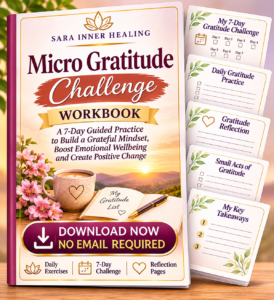
Sara Inner Healing Gratitude Challenge Workbook
Overcoming Cognitive Barriers and Toxic Positivity
A common barrier to successfully completing any mindfulness program is the pressure to feel artificially happy. When your life is complicated, forcing a cheerful attitude feels dishonest. This challenge does not ask you to mask your reality. Instead, it teaches you to notice small pockets of comfort alongside your struggles, protecting your psychological boundaries while expanding your emotional capacity.
By lowering the bar from “finding absolute joy” to “identifying basic safety,” you remove the performance anxiety often associated with modern self-care. This strategic adjustment makes the challenge sustainable for people processing heavy life shifts, complex grief, or chronic mental burnout.
The 10-Day Step-by-Step Challenge Blueprint
To get the most out of this challenge, move through these days in order. You only need to focus on the specific prompt assigned to each day.
Day 1: The Ambient Temperature Anchor
- The Action: Pause for 30 seconds after waking up. Notice the exact temperature of your room or the cozy warmth trapped beneath your blanket.
- The Purpose: This sensory realization grounds your analytical mind into physical comfort before your daily to-do list takes over your thoughts.
Day 2: The Mundane Tool Reframe
- The Action: Choose an everyday object you use without thinking—such as your house key, your phone, or a smooth writing pen. Spend 30 seconds acknowledging how much easier this small item makes your afternoon.
- The Purpose: This shifts your focus away from what is missing, highlighting the subtle conveniences already supporting your routine.
Day 3: The Hot Water Intermission
- The Action: While washing your hands or taking a shower, focus entirely on the physical sensation of the hot water against your skin. Turn off your thoughts and absorb the physical comfort for 60 seconds.
- The Purpose: This brings your awareness away from future anxieties, acting as a gentle somatic brake on a racing nervous system.
Day 4: The Strategic Mirror Pause
- The Action: Look at your reflection while brushing your teeth. Instead of checking for flaws, look yourself in the eyes and mentally offer a word of thanks to your body for its continuous, silent resilience.
- The Purpose: This acts as a gentle antidote to self-criticism, anchoring your self-identity to internal appreciation.
Day 5: The “Even Though” Linguistic Alignment
- The Action: Open a notebook or text file and write a single sentence using this exact layout: “Even though [insert your current stress or frustration], I am thankful for [insert one steady constant in your life right now].”
- The Purpose: This linguistic framework validates your genuine pain while gently pointing your brain toward a supportive safety net. For a deeper look into the foundational mechanics of this practice, take a moment to explore our comprehensive article on what is a gratitude journal.
Day 6: The Digital Space Reset
- The Action: Before you open your phone to scroll through social media or look at your inbox, hold the dark device in your hand for three deep breaths. Acknowledge the physical peace of your immediate environment before inviting external noise inside.
- The Purpose: This builds an intentional boundary between your conscious mind and digital triggers, protecting your morning energy.
Day 7: The Unchanged Constant Audit
- The Action: Identify one major element in nature or your environment that remains completely unaffected by your personal stress—such as the predictable rising of the morning sun, the solid ground beneath your feet, or the steady growth of a houseplant.
- The Purpose: This counters your brain’s tendency to catastrophize, proving to your subconscious that the foundation of your world remains structurally secure.
Day 8: The Restorative Frequency Shift
- The Action: Set aside 60 seconds to sit in a quiet space without any digital notifications. Close your eyes and focus entirely on the natural, rhythmic cadence of your breath moving in and out of your body.
- The Purpose: This somatic practice stimulates your parasympathetic nervous system, easing the physical tension held in your chest or shoulders.
Day 9: The Relational Acknowledgment
- The Action: Think of one person, historical figure, writer, or community member who allows you to show up exactly as you are without requiring you to fake a smile. Send them a quick text or silently appreciate their presence in your life.
- The Purpose: This reminds your nervous system of relational safety, counteracting the heavy feelings of isolation that often accompany emotional burnout.
Day 10: The Evening Release
- The Action: Right before you close your eyes to sleep, identify one tiny micro-glimmer of comfort from your day—a hot meal, a moment of quiet, or a soft pillow. Write it down or hold the image in your mind as you drift off.
- The Purpose: This offloads leftover daytime anxieties, preparing your subconscious mind for deep, restorative rest.
Addressing Spiritual Static and Deep-Seated Blocks
There are seasons when your internal resistance runs so deep that participating in basic mindset challenges feels completely empty or emotionally numb. In many spiritual paths, this profound mental exhaustion or persistent emotional wall indicates a deeper blockage within your soul’s energetic blueprint. When your conscious willpower is obstructed by spiritual static, practical tools must be elevated into the realm of sacred, timeless intervention.
To address deep-seated emotional and spiritual blocks, you can pair daily mindfulness practices with targeted resources like the Kabbalistic Prayers & Psalms For Healing Master Glossary.
Expanding Your Practice
- Morning Routines: Build on your momentum by establishing a dedicated gratitude morning routine.
- Journaling Frameworks: Transition to written reflections using guides on how do I start a gratitude practice or specialized journals for men and women.
- Specialized Healing: Integrate the challenge with resources addressing grief and gratitude, shadow work gratitude, and what is micro-gratitude.