What Is Somatic Gratitude? (Feeling Thankfulness in Your Body)
When we discuss personal development or the practice of intentional appreciation, we almost always treat it as a purely intellectual exercise. We are instructed to look at our lives through a logical lens, think about what is going well, and write down a list of our blessings in a notebook. While this cognitive approach is an excellent starting point, it often falls short when you are navigating deep emotional burnout, recovering from intense trauma, or living with chronic stress.
On heavy days, your analytical mind might be completely exhausted, making the act of searching for positive thoughts feel like an impossible uphill battle. You might look around your room and intellectually know that you have a roof over your head, but your body still feels tightly wound, anxious, and deeply unsettled.
To experience complete inner healing, you must bridge the gap between your thoughts and your physical form. This is the foundation of somatic gratitude—a transformative practice that shifts your focus away from abstract mental concepts and guides your awareness directly into the living, breathing reality of your physical nervous system.
The Body Keeps the Score: Why Logic Isn’t Enough
Neuro_Somatic_Blueprint – CLICK TO DOWNLOAD
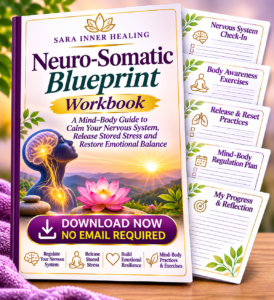
Neuro Somatic Blueprint
Neuro_Somatic_Blueprint – Copy
The term “somatic” comes from the Greek word soma, which means the living body. In modern psychological and healing frameworks, somatic practices acknowledge a profound truth: your body stores your emotional history. When you experience prolonged anxiety, a difficult life transition, or an unhealed emotional wound, the stress doesn’t just exist in your head. It physically gets trapped within your tissues, your muscles, and your autonomic nervous system.
This is why you can read hundreds of positive affirmations or intellectually tell yourself that you are safe, while your chest still feels incredibly tight, your stomach is knotted, and your jaw is clenched. Your nervous system is operating in a primitive survival state of fight-or-flight, completely detached from your logical thoughts.
Trying to force a feeling of thankfulness over a physically terrified or defensive body creates a deep sense of internal friction. Somatic appreciation flips the traditional model upside down. Instead of trying to use your thoughts to change your feelings, you use your body’s immediate physical sensations to gently calm your mind.
The Vagus Nerve Connection: The Science of Somatic Safety
To understand why this body-based shift works so profoundly, you must look at your autonomic nervous system, specifically the vagus nerve. The vagus nerve is the longest cranial nerve in your body, serving as the primary highway of communication between your brain and your internal organs. It is the core engine behind your parasympathetic nervous system—the network responsible for your “rest, digest, and heal” state.
When you are stressed or emotionally overwhelmed, your sympathetic nervous system takes complete control, preparing your body to fight or flee. To deactivate this survival response, you cannot simply think your way to peace; you must send a physical signal of safety directly to your brain via the vagus nerve.
When you practice somatic appreciation, you aren’t looking for abstract life achievements. You are searching your physical body for tiny, localized zones of comfort, ease, or neutrality. It might be the gentle warmth of your hands resting against your stomach, the solid, unyielding support of the chair beneath your thighs, or the cool sensation of air moving through your nostrils.
The moment your conscious mind zeroes in on a physical sensation of comfort, your vagus nerve fires, releasing a wave of calming neurochemicals that immediately slow your heart rate, lower your blood pressure, and ease muscle tension.
A 3-Minute Somatic Grounding Ritual
If you are feeling completely disconnected from your peace or find yourself trapped in a heavy mental loop, set your notebook aside and try this simple, low-energy body alignment practice:
- Find a Physical Anchor: Sit or lie down in a comfortable position. Place one palm flat over your heart center and the other gently on your lower belly. Soften your gaze or close your eyes completely.
- Scan for Physical Neutrality: Do not try to force a feeling of overwhelming joy. Instead, slowly scan your body from head to toe, looking simply for an area that feels completely neutral, safe, or comfortable. Focus on the physical contact point where your hands meet your chest, or notice the solid weight of your body pressing into the bed or chair.
- Breathe into the Comfort: Once you locate that small physical anchor of ease, rest your attention there completely. As you take a slow, deep inhale, imagine sending that breath directly into that zone of physical safety. As you exhale, let your shoulders drop and allow your muscles to soften into that support.
- Offer Somatic Thanks: Keep your focus on that pleasant sensation and whisper silently to your form: “Thank you to my body for breathing for me. Thank you for protecting me, carrying me, and keeping me steady through this moment.”
Dissolving Somatic Numbness with Spiritual Keys
There will be mornings when you try to connect with your body and you find absolutely nothing but an overwhelming wall of numbness, heavy physical exhaustion, or intense internal static. When your nervous system has been overstimulated for months or years, it will occasionally enter a state of total shutdown or freeze to protect you from further burnout. On these days, even a simple physical scan can feel completely blocked.
In ancient spiritual paths, this profound bodily freeze or persistent lack of life force points toward a deeper energetic compromise within the soul’s protective blueprint. When your physical form resists mental conditioning, you can use sacred ancestral words to clear the heavy density out of your immediate atmosphere.
Elevating your somatic practice into a space of divine alignment breaks through the energetic gridlock that logic cannot dissolve. If you feel physically stuck or emotionally attacked upon waking, browse our comprehensive Kabbalistic Prayers & Psalms For Healing Master Glossary to find targeted spiritual formulas to cleanse your field and safely re-align your energetic anatomy.
Building Your Comprehensive Self-Care Ecosystem
As somatic practices help calm your nervous system, you can naturally transition these body-based discoveries into structured writing habits by exploring guides on how do I start a gratitude practice. Incorporating physical tools like dedicated gratitude journals for women or men can further anchor your routine.
Additionally, combining somatic scans with resources addressing grief and gratitude, shadow work gratitude, or consistent journaling tips helps protect your emotional well-being during challenging periods.