
How to Practice Gratitude When Depressed: A Gentle Guide for Inner Healing
When you are walking through the heavy, gray fog of depression, being told to “count your blessings” can feel deeply invalidating. Traditional self-help advice often implies that if you just forced a happy smile and listed what you were thankful for, your struggles would magically vanish.
This approach doesn’t work because depression isn’t a lack of appreciation—it is a state of survival where your nervous system feels completely overwhelmed.
If you are currently struggling to find motivation, forcing yourself to feel a random wave of joy will only create an internal disconnect. True inner healing doesn’t ask you to pretend you are okay when you aren’t. Instead, it invites you to gently look for tiny anchor points of comfort without shaming yourself for feeling low. If you are entirely new to tracking your thoughts in this way, you can review our foundational guide on what is a gratitude journal.
The Danger of Toxic Positivity in Mental Health Recovery
Inner_Healing_Crisis_Kit – CLICK TO DOWNLOAD
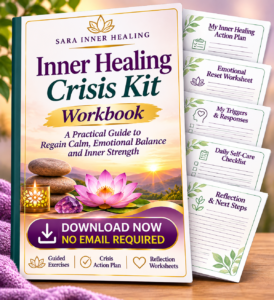
Sara Inner Healing Crisis Kit
There is a massive difference between genuine appreciation and toxic positivity. Toxic positivity demands that you suppress your authentic pain, grief, or anger to replace it with a forced positive attitude. When you are depressed, this makes you feel like you are failing at being positive on top of already feeling miserable.
Real gratitude doesn’t replace depression; it coexists with it. It is a gentle tool used to spot tiny, quiet safety nets in your immediate environment. You do not have to feel an overwhelming rush of happiness for the practice to work. Simply the physical and mental act of looking for something comforting helps stimulate your mind and slowly rewires your focus away from a total survival state.
3 “Low-Energy” Steps to Practice Gratitude Today
When your mental energy is at zero, you cannot approach mindfulness the same way you would on a good day. Here are three incredibly low-barrier, compassionate steps to try when things feel heavy:
1. Look for Micro-Glimmers Instead of Blessings
Do not search for massive, life-altering blessings. Instead, look for “glimmers”—tiny micro-moments of physical safety or sensory comfort in your room right now.
- The exact temperature of the water you are drinking.
- The soft texture of the blanket resting against your skin.
- The fact that the room is quiet and you are allowed to rest.
2. Use the “Even Though” Sentence Frame
Depression often makes your mind argue with positive statements. To bypass this internal resistance, use an “Even Though” sentence structure. This validates your pain while still pointing out a steady constant.
- “Even though my body feels completely exhausted today, I am glad I have a comfortable bed to rest in.”
- “Even though everything feels incredibly overwhelming right now, I am thankful for this hot cup of tea.”
3. Remove the Pressure to Feel Joy
Remind yourself that you do not need to feel a magical wave of happiness when you write or think about something comforting. The healing benefits happen during the search. Simply pausing to think, “What is one thing that feels safe right now?” begins building momentum in your brain, even if you feel completely emotionally numb while doing it.
Gentle Gratitude Prompts for Deeply Heavy Days
If you want to put pen to paper but don’t know where to start, pick just one of these short, non-overwhelming prompts tonight. You only need to write a single sentence:
- What is one physical object near me that brings a tiny bit of comfort or ease?
- Who is someone in my life or online community who lets me be exactly as I am without expecting me to fake a smile?
- What is a gentle sound I can hear right now that anchors me to this exact room?
- What is one small boundary I set today to protect my energy?
- Write down the phrase: “Even though today was hard, my body kept breathing through it, and I am safe right now.”
For a broader list of entry-level writing inspirations and ideas, explore our full list of 50 gratitude journal prompts for beginners.
Advanced Somatic Practices: Moving Gratitude from the Mind to the Body
When severe depression hits, the analytical mind often shuts down. Trying to think logically about what you appreciate can feel exhausting. When this happens, the most effective path to healing is to move your practice entirely out of your thoughts and into your body. This is known as somatic gratitude.
Your nervous system stores the physical tension of depression, trauma, and anxiety. To gently release this grip, try this three-minute somatic grounding exercise:
- Find a Physical Anchor: Place one hand over your heart and the other on your belly. Close your eyes if it feels safe, or simply soften your gaze toward the floor.
- Scan for Comfort: Instead of thinking about abstract concepts, scan your body for any zone that feels neutral or comfortable. It might be the warmth of your hands against your chest, the solid support of the chair beneath your thighs, or the rhythmic flow of your breath.
- Breathe into the Sensation: Focus your attention completely on that small physical anchor. As you inhale, imagine sending breath to that specific area, silently acknowledging its presence.
By focusing on a physical sensation of comfort, you send a direct signal to your vagus nerve that you are safe in this exact moment. This somatic shift gently coaxes your body out of a survival state and begins restoring emotional balance.
Tailoring Your Practice: Choosing Tools That Match Your Energy
Healing is not a one-size-fits-all journey. On some days, you may have the emotional energy to write a paragraph; on other days, simply looking at a comforting phrase is all you can manage. The key to staying consistent is meeting yourself exactly where you are without judgment.
If you prefer structured routines, utilizing dedicated physical journals can take the guesswork out of your daily practice. For instance, using targeted layouts like The Ultimate Gratitude Journal For Women or The Ultimate Gratitude Journal For Men provides a clear, comforting framework so you don’t have to face a intimidating blank page when your energy is low.
Alternatively, if opening a notebook feels too heavy on a bad mental health day, you can lean on passive tools. Keeping visual items like spiritual affirmation cards on your nightstand or playing grounding, restorative music can shift the ambient energy of your room, allowing you to absorb healing frequencies without requiring active effort.
When Your Mind Resists: What to Do When You Feel Nothing
There will be days when your mind completely resists this practice, and that is a completely normal part of depression. If you look around your room and find absolutely nothing to appreciate, don’t force it.
On those days, your only job is to offer yourself complete compassion. Change the practice from gratitude to radical acceptance: “Right now, everything feels impossible, and I am going to let myself rest without judging myself for it.”
Healing is not a straight line. By lowering the bar and treating yourself with immense gentleness, you are protecting your peace and keeping the door open for brighter glimmers when your energy naturally returns.
“If you want to explore the deeper, spiritual side of how intentional appreciation transforms your hidden patterns, check out our guide on how gratitude supports soul correction.”